August 7, 2017

Going Around Siem Reap Small Circuit Temples

After a half-day tour of Angkor Wat, we asked our tuktuk driver to take us to a place where we can have our lunch. The second-half of our day is visiting the temples which is part of the Small Circuit. Usually the Small Circuit tour will start in the Bayon Temple but since we decided to have our lunch first we will do the tour in reverse order.

The first temple we visited that is part of the Small Circuit is Banteay Kdei. Banteay Kdei means a "A Citadel of Chambers". 


There are some stalls of paintings once you entered Banteay Kdei. The paintings differ in sizes. The paintings are usually about Angkor Wat or the other temples in Cambodia like the Bayon Temple.


 A Buddha is placed in the entrance of the whole structure. Many Buddhist temples were built, including the Banteay Kdei, from middle of the 12th century to early 13th century.


 Main attraction of Banteay Kdei is the large tree which located at the back. Below are some of the pictures of Banteay Kdei.


Just like Angkor Wat, Banteay Kdei has a lot of carvings. It is common to see Apsaras Devata carvings in the columns of the temple. 


Restorations are being done for the temple. A project in 2004 by the University of California and Sophia University of Tokyo in partnership with the non-profit group Cyark was done. Laser scans of Banteay Kdei and and Angkor Wat Causeway were performed.

Located in the east side of Banteay Kdei is Srah Srang or "the royal bathing pool". The approaching steps to the water edge are flanked by two stone statues of lions with ornamented Naga balustrades. The rain already poured in so we were unable to take a picture of the lake.


Our next temple is Ta Phrom. Aside from its large trees with their roots sprawling over the temple, Ta Phrom became more famous after Angelina Jolie's Tomb Raider was done there.


Ta Phrom was a Buddhist temple. Ta Phrom was originally known as Rajavihara or the Monastery of the King. During that time, almost 80,000 people were required to maintain the temple.


Ta Phrom is one of the temples with many visitors and places of interest gets easily crowded. On-going restoration is being done when we visited the temple.


The next temple in the Small Circuit we went to is not for a person afraid of heights with open spaces. Known as the temple mountain is Ta Keo. The steps in Ta Keo are very steep making it hard to reach the top. The temple was never completed and restoration to preserve the temple is being done.


This is a glimpse of the interior of the temple. You can see the forest surrounding the temple when you are on the top.


Thommanon and Chau Say Tevada are small temples situated across each other. It was a break from all the large temples that we have explored. We only spent little time exploring these temples.

Thommanon

Thommanon
Chau Say Tevada

Chau Say Tevada
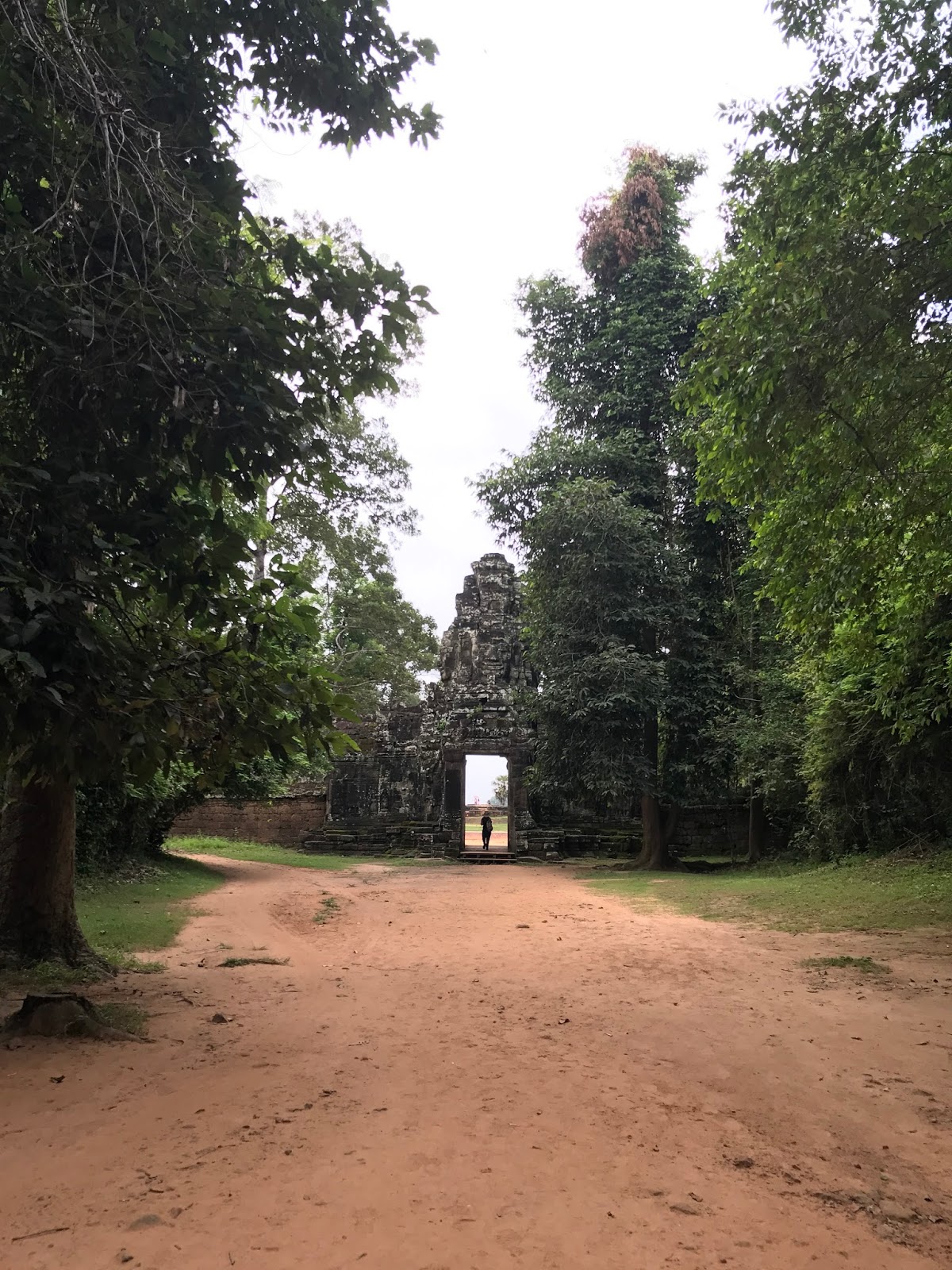
Another large temple that we visit is the Bayon temple. Bayon temple is famous for the stone face in its temples. There are 216 gigantic faces on the temple's towers.


Bayon was built around 1190 AD by King Jayavarman II. They say that that smiling faces of the temple is a portrait of King Jayavarman. Bayon is a Buddhist temple. At the entrance of the temple is a huge buddha. After the death of Jayavarman II, King Jayavarman III turned the temple to Hindu.


Bayon is the largest temple complex among the temples of Small Circuit. It might be quite exhausting just looking on how big the temple is.

Near the Bayon temple is Baphuon. Baphuon is a three-tiered temple located northwest of Bayon. The temple is dedicated to the Hindu God Shiva. Most of the part of the temple has collapsed and restoration is still ongoing. Rubble of the temple can be seen on the entrance.


On the way back to our hotel, we saw the Terrace of the Elephant. It is part of the walled city of Angkor Thom. The Terrace of the Elephant now lay in ruins. It was used before by King Jayavarman II to view his returning army.


We still don't want to leave the place yet but it was almost 5PM and temple visits ends at this time. It was also already raining that time.

This is the second day of out Siem Reap tour which is mainly about Angkor Wat and the Small Cicuit temples.


June 25, 2017

A Day in Angkor Wat

This post is part of my Cambodia travel and I hope I could finish my other post of a more detailed information of my trip in Cambodia. Actually, my trip was more focus in Siem Reap. The province where the largest religious monument is located which is the Angkor Wat.

To give a much clearer picture of what to expect of Angkor Wat it is best to explain the whole Angkor Complex. This is a bit confusing when you are doing your itinerary and looking for details on how to plan your trip. The Angkor Wat is located within the Angkor Complex along with other temples like Angkor Thom and Bayon Temple. 


The tour in Angkor Wat can be completed within three hours depending on your pace. We visited during the dry season and although the weather was very humid there are a lot of tourist in the place. 

To be able to visit Angkor Wat and other temples you need to buy an Angkor Pass. A single day pass cost $37.00, a three-day pass is $62 which is valid for ten (10) days and the seven-day pass is worth $72. The Angkor Pass contains your photo which will be taken when you buy the pass. The Angkor Pass is bought in the Angkor Conservation Area ticket booth on Charles de Gaulle road. It is the road between Siem Reap and Angkor Wat. There is a checkpoint before entering the Angkor Complex wherein you will be required to show your pass.

There are lots of tour package for Angkor Wat but it is much cheaper to just hire a tuktuk driver to bring you to Angkor Wat and to the other temples.


When you visit the temples you will notice that they are usually surrounded by waters. A local explained to us that a pond or river surrounds the temples so that it cannot be easily invaded. In Angkor Wat, the temple is also surrounded by a forest.


The Angkor Wat is built for the God Vishnu. It was built during the reign of Suryavarman II. It was built as the king’s state temple and capital city. Angkor Wat was gradually transformed from a Hindu center of worship to Buddhism towards the end of 12th century. Restoration of the temple started in the 29th century which mainly involves the removal of the accumulated earth and vegetation.

Aside from its architecture, Angkor Wat is famous for its intricate carvings in the walls. 


When you enter Angkor Wat, there is a corridor which is filled carvings. The corridor is less visited by tourists but is good place to start understanding how beautiful the temple is.


The Angkor Wat temple has five towers. The central tower of Angkor Wat symbolizes the Mount Meru which is considered as a sacred mountain


Since Angkor Wat is a temple which means it is holy, tourists must follow a dress code. Knees and shoulders should be covered. And they don't allow tourists to enter even if the shoulders are covered by just a shawl. 


 A view of the outer Angkor temple can be seen when you go up the towers. Dress code is strictly implemented when going up the towers. There are also only certain number of visitors allowed to climb the tower. There is a line to maintained in entering the towers. The stairs going to the tower is steep making it difficult for visitors to easily climb the towers.

There are some parts of Angkor Wat which is less visited by tourists which is some of the best place to take some pictures. 


There are still some monks in the temple. It is strictly prohibited to take a picture with a monk. If you really want to take a picture with them, you must ask permission first. 


Aside from tourists there are also locals whose main source of income is the tourism of Angkor Wat. There are photographers who will take your picture with the background of the temple. There are also stalls where you can buy some foods and souvenirs.

Tourists usually watch the sunrise over the Angkor Wat temple. We did our sunrise watching the next day since we bough a three day pass. Many tourists woke up early to watch the sunrise over the temple. Unfortunately it was a bit gloomy during our visit despite it is the dry season and the sun shine a faint color of pink and purple in the sky.


After a three or four hour tour in Angkor Wat temple, you may have an option to visit the Small Circuit temples or the Grand Circuit Temples.